
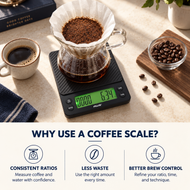
Best Food Scale for Weighing Coffee Beans
Published by AWS Team on 10th Sep 2026
Great coffee depends on repeatable measurements. You can buy freshly roasted beans, use filtered water, invest in a quality grinder, and carefully control your brewing temperature—but your results may still vary if you measure coffee with a scoop.
Coffee beans do not have a consistent volume. Their size, shape, roast level, density, and freshness can all affect how much coffee fits into a tablespoon or scoop. Two visually identical scoops can contain noticeably different amounts of coffee.
A digital food scale solves this problem by measuring coffee beans in grams. Once you know exactly how much coffee and water you use, you can repeat a successful recipe or make deliberate adjustments when a cup tastes too strong, weak, bitter, or sour.
The best food scale for weighing coffee beans should offer fine resolution, fast readings, an effective tare function, sufficient capacity, and a platform large enough for your preferred brewing equipment. Additional features—such as a timer, illuminated display, protective cover, or spill-resistant controls—may also improve the brewing process.
This guide explains how to select a coffee scale, how much precision you need, and how to weigh beans and water for espresso, pour-over, French press, cold brew, and automatic drip coffee.
Why Weigh Coffee Beans Instead of Using a Scoop?
Scoops are convenient, but they measure volume rather than mass. Volume can be unreliable when the ingredient being measured changes in density.
Coffee beans vary for several reasons:
-
Dark-roasted beans are generally less dense than light-roasted beans.
-
Bean size differs among coffee varieties and growing regions.
-
Roasting changes the structure, moisture, and density of a bean.
-
Broken beans and small fragments fill empty spaces inside a scoop.
-
A rounded scoop contains more coffee than a level scoop.
-
Ground coffee settles differently depending on grind size.
-
Static can cause grounds to remain inside a grinder or dosing cup.
A recipe that calls for “two scoops” therefore leaves considerable room for interpretation. A recipe that calls for 30 grams of coffee and 500 grams of water is much easier to reproduce.
Weighing also makes troubleshooting more systematic. If a pour-over tastes weak, you can keep the dose constant and adjust the grind, water quantity, or brew time. If you do not know the original dose, you have too many uncontrolled variables.
The same principle applies to espresso. A small change in coffee dose can affect how much space remains in the portafilter basket, how water moves through the coffee bed, and how the final shot tastes.
A scale does not replace brewing skill, but it gives you reliable information. That information makes every other adjustment more meaningful.
Quick Answer: What Is the Best Type of Coffee Scale?
For most home coffee drinkers, the best choice is a digital scale with:
-
Measurements in grams
-
Resolution of 0.1 gram
-
Capacity of at least 2,000 grams
-
A responsive tare button
-
A stable platform
-
A clear display
-
Enough room for a mug, server, dripper, or portafilter
-
Controls that remain accessible when brewing equipment is on the platform
A 0.1-gram scale is precise enough for whole-bean doses, pour-over brewing, espresso output, and most other home coffee applications.
A scale with 0.01-gram resolution can be helpful for very small doses, recipe development, or weighing additives. However, hundredth-gram readings are not essential for an ordinary 15- to 30-gram coffee dose.
Capacity is equally important. A highly precise pocket scale may work well for weighing beans, but it may not have enough capacity or platform space to support a brewer, carafe, and several hundred grams of water.
For a versatile household option, explore the complete selection of digital kitchen scales from American Weigh Scales.
Understanding Coffee Scale Accuracy and Resolution
Accuracy and resolution are related, but they do not mean exactly the same thing.
Resolution—sometimes called readability or graduation—is the smallest increment displayed by a scale. A model that reads in 0.1-gram increments might display 20.0, 20.1, and 20.2 grams.
Accuracy describes how close a measurement is to the actual mass being measured. A scale may display several decimal places without necessarily producing an equally accurate measurement under every condition.
For coffee brewing, you should consider repeatability as well. A useful coffee scale should provide the same or nearly the same reading when you weigh the same item several times under consistent conditions.
Is 1-Gram Resolution Enough for Coffee?
A scale that measures in 1-gram increments can work for large batches of drip coffee or cold brew. If a recipe uses 100 grams of coffee and 1,600 grams of water, a one-gram difference is unlikely to ruin the batch.
It is less suitable for espresso or small single-cup recipes. One gram represents:
-
5% of a 20-gram espresso dose
-
About 6.7% of a 15-gram pour-over dose
-
10% of a 10-gram single-cup dose
Those are meaningful differences. A scale may also round readings, leaving you uncertain whether a displayed 20 grams represents slightly more or less than your intended dose.
A 0.1-gram scale gives you better control without creating unnecessary complexity.
Do You Need 0.01-Gram Resolution?
A 0.01-gram scale can be useful when:
-
Measuring very small coffee doses
-
Comparing grinder retention
-
Weighing individual beans during experiments
-
Measuring mineral concentrates or recipe additives
-
Dividing expensive coffee into exact sample portions
-
Testing dose consistency for competitions or quality control
For everyday brewing, 0.1 gram is normally a better balance of precision, capacity, platform size, and ease of use.
The ACPRO-220 digital pocket scale provides a 220-gram capacity with 0.01-gram readability. Its fine resolution makes it suitable for measuring beans separately before transferring them to a grinder.
What Capacity Should a Coffee Scale Have?
The correct capacity depends on what you intend to place on the scale.
If you only plan to weigh whole beans in a small cup, a pocket scale with a capacity of 100 to 500 grams may be sufficient.
If you want to brew directly on the scale, calculate the combined mass of:
-
The brewing device
-
The cup or server
-
The coffee
-
The water
-
Any stand, filter holder, or dosing container
A ceramic dripper, glass carafe, and 500 grams of water can easily exceed 1,000 grams. A French press or large batch brewer may require considerably more capacity.
For general coffee use, a capacity between 2,000 and 5,000 grams provides flexibility. It allows you to weigh beans separately or place an entire brewing setup on the platform.
The KF-5KG digital kitchen scale combines a 5,000-gram capacity with 0.1-gram readability. That combination is useful for coffee drinkers who want precise doses without sacrificing the capacity needed for larger brewing equipment.
For commercial preparation, large cold-brew batches, or other high-capacity kitchen work, the PREPLITE-10KG kitchen scale offers a higher maximum capacity. Its 1-gram readability is best suited to substantial batches rather than extremely small espresso adjustments.
The Most Important Features in a Coffee Bean Scale
Coffee scales are used differently from ordinary food scales. When weighing flour or produce, you can usually wait for a reading and remove the item. Coffee brewing can involve gradually pouring water while watching the display in real time.
The following features can make a meaningful difference.
1. Gram Measurements
Grams are the standard practical unit for coffee recipes. They make ratio calculations straightforward because one milliliter of water has a mass close to one gram under normal brewing conditions.
Instead of switching between fluid ounces for water and ounces for coffee, you can measure both ingredients on the same scale using grams.
For reference, the National Institute of Standards and Technology explains SI units of mass, including the kilogram and its relationship to everyday measurements.
2. At Least 0.1-Gram Readability
A scale displaying tenths of a gram provides useful control for both whole beans and brewed espresso. It lets you distinguish between doses such as 17.8, 18.0, and 18.2 grams.
This does not mean you must obsess over every tenth of a gram. The benefit is that the scale gives you enough information to decide how precise you want to be.
3. Fast Response Time
A responsive scale is particularly important when measuring water during a pour-over or espresso as it enters a cup.
If the display lags significantly behind the pour, you may stop at 300 grams only to discover that the final measurement settles at 310 grams. That overshoot changes your coffee-to-water ratio.
A fast display also makes it easier to pour in controlled stages and monitor bloom water.
4. Reliable Tare Function
Tare resets the displayed value to zero while a container remains on the platform.
For example:
-
Place an empty dosing cup on the scale.
-
Press tare.
-
Add coffee beans.
-
Read only the mass of the beans.
During pour-over brewing, you can place the server and brewer on the platform, tare the setup, add ground coffee, tare again, and then measure the brewing water.
An accessible tare button is more important than it may initially appear. If a large carafe blocks the controls, the brewing process becomes unnecessarily awkward.
5. Appropriate Platform Size
Pocket scales are excellent for weighing beans but may be too small for brewing directly into a carafe. Large equipment can overhang the platform and obscure the display.
Choose a platform that comfortably supports the widest item you expect to use. The container should sit flat without touching the countertop or another appliance.
The AMW-2000 digital bench scale offers a 2,000-gram capacity, 0.1-gram readability, and a stainless-steel platform. It is a practical option when you want more working area than a compact pocket scale provides.
6. Easy-to-Read Display
Coffee is often prepared early in the morning, in dim kitchens, or beneath cabinets that cast shadows over the counter. A backlit display can make readings easier to see.
Check whether a brewer or mug will block your view. Front-facing displays are generally easier to monitor during active brewing than displays positioned directly beneath the platform.
7. Sensible Auto-Off Behavior
Automatic shutoff conserves battery power, but a short shutoff interval can interrupt a long pour-over, immersion brew, or cold-brew preparation.
If a scale has an auto-off function, determine whether the timer is long enough for your workflow. Some scales remain active while the displayed mass is changing, while others may turn off after a fixed period.
8. Stable Feet and Level Placement
A scale should remain stable when you press its buttons or pour water into a brewer. Non-slip feet can reduce movement on smooth countertops.
The surface underneath the scale must also be level, rigid, and free from vibration. A flexible mat, uneven tile, running grinder, or nearby appliance may cause unstable readings.
9. Easy Cleaning
Coffee grounds migrate everywhere. Water droplets, oils, milk, and syrup can also reach the weighing platform.
A smooth platform is generally easier to wipe than one with deep seams or complicated edges. If a scale is not advertised as waterproof, do not rinse or submerge it. Wipe the surface with a slightly damp cloth and dry it promptly.
Coffee-to-Water Ratio Explained
A coffee-to-water ratio compares the mass of dry coffee to the mass of brewing water.
A ratio of 1:16 means using one gram of coffee for every 16 grams of water. For example:
-
15 grams of coffee × 16 = 240 grams of water
-
20 grams of coffee × 16 = 320 grams of water
-
30 grams of coffee × 16 = 480 grams of water
-
60 grams of coffee × 16 = 960 grams of water
The Specialty Coffee Association discusses 60 grams of coffee per liter of water, equivalent to approximately 1:16.7, as a commonly used reference point for drip and immersion brewing.
That does not make 1:16.7 the only correct ratio. It is a useful starting point, not a rule that overrides personal taste.
The Specialty Coffee Association’s discussion of brewing ratios explains how coffee and water measurements can be expressed as grams per liter or as a ratio.
Common Starting Ratios
| Brewing method | Starting ratio | Example |
|---|---|---|
| Pour-over | 1:15 to 1:17 | 20 g coffee to 300–340 g water |
| Automatic drip | 1:15 to 1:17 | 60 g coffee to 900–1,020 g water |
| French press | 1:14 to 1:17 | 30 g coffee to 420–510 g water |
| AeroPress-style brewing | 1:10 to 1:16 | 15 g coffee to 150–240 g water |
| Cold brew concentrate | 1:4 to 1:8 | 100 g coffee to 400–800 g water |
| Ready-to-drink cold brew | 1:10 to 1:16 | 75 g coffee to 750–1,200 g water |
These ranges are starting points. Grind size, water temperature, contact time, agitation, roast level, and brewing equipment all affect extraction and flavor.
The Specialty Coffee Association’s coffee standards provide broader context for how the coffee industry approaches brewing performance, evaluation, and consistency.
Best Scale Setup for Espresso
Espresso requires a compact, responsive scale because the dose and beverage yield are relatively small.
Many espresso recipes use a relationship between the dry coffee dose and the liquid espresso yield. For example, a 1:2 recipe might use:
-
18 grams of ground coffee
-
36 grams of espresso in the cup
Here, the first number refers to coffee input and the second to beverage output. This is not the same as a pour-over ratio because espresso yield includes dissolved coffee material and is measured as the finished beverage.
What to Look for in an Espresso Scale
An espresso scale should have:
-
At least 0.1-gram readability
-
A quick display response
-
A compact body that fits on the drip tray
-
A platform large enough for an espresso cup
-
Controls that remain visible beneath the cup
-
A maximum capacity that safely accommodates the cup and beverage
A timer is convenient because espresso recipes are frequently described by dose, yield, and time. However, you can also use a separate timer if the scale meets your measurement needs.
How to Weigh an Espresso Dose
-
Turn on the scale on a stable counter.
-
Place an empty dosing cup or portafilter on the platform.
-
Press tare.
-
Add or grind the beans.
-
Adjust until the intended dose appears.
-
Prepare and tamp the coffee.
-
Place the espresso cup on the scale.
-
Press tare again.
-
Start the shot and timer.
-
Stop at the target beverage mass.
If your grinder retains coffee, the mass of beans entering the grinder may not exactly equal the mass of grounds leaving it. Weighing the final ground dose helps identify this difference.
For small-dose work where hundredth-gram readings are helpful, the CARDV2-200 compact digital pocket scale provides a 200-gram capacity and 0.01-gram readability.
Best Scale Setup for Pour-Over Coffee
Pour-over brewing benefits greatly from a scale because both coffee and water can be measured throughout the process.
A suitable scale must support the combined mass of the server, dripper, coffee, filter, and water. It should also update quickly as water is poured.
Example Pour-Over Recipe
A straightforward starting recipe might use:
-
20 grams of coffee
-
320 grams of water
-
A 1:16 coffee-to-water ratio
You could divide the water into stages:
-
50 grams for the bloom
-
Pour to 160 grams
-
Pour to 240 grams
-
Finish at 320 grams
Because the scale displays cumulative water mass, you do not have to estimate how much water is in each pour.
How to Weigh a Pour-Over
-
Place the scale on a dry, level counter.
-
Put the server, dripper, and rinsed filter on the platform.
-
Tare the scale.
-
Add the ground coffee.
-
Confirm the dose and tare again.
-
Start the timer as you begin adding bloom water.
-
Watch the live mass while pouring.
-
Continue to the target water mass.
-
Allow the brewer to drain before removing it.
The scale turns a vague instruction such as “pour a little more water” into a repeatable process.
Best Scale Setup for French Press
French press coffee is forgiving, but weighing still improves consistency.
Because the brewer may be made from heavy glass or stainless steel, capacity and platform stability are important. A small pocket scale might accurately measure the beans yet be unsuitable for supporting the entire press.
You can use either of two methods.
Method One: Weigh Beans and Water Separately
Weigh the beans in a dosing cup, then measure the water in a separate container. This works when your scale has a small platform or limited capacity.
Method Two: Brew Directly on the Scale
Place the empty French press on a higher-capacity scale, tare it, add the ground coffee, tare again, and pour to the desired water mass.
For a 1:15 recipe:
-
30 grams of coffee requires 450 grams of water.
-
40 grams of coffee requires 600 grams of water.
-
60 grams of coffee requires 900 grams of water.
The National Coffee Association’s brewing guide provides an overview of popular preparation methods, including French press, pour-over, drip coffee, espresso, and cold brew.
Best Scale Setup for Automatic Drip Coffee
Automatic coffee makers are often filled using lines printed on the reservoir or carafe. Those markings may be convenient, but “cups” on coffee equipment do not always correspond to an eight-fluid-ounce household cup.
Weighing eliminates that ambiguity.
Place the empty carafe on the scale, tare it, and add the desired mass of water. Pour that water into the reservoir. Then weigh the coffee separately.
For example, using a 1:16 ratio:
| Water | Coffee |
|---|---|
| 500 g | 31.25 g |
| 750 g | 46.9 g |
| 1,000 g | 62.5 g |
| 1,250 g | 78.1 g |
| 1,500 g | 93.75 g |
You do not need to hit every hundredth of a gram shown by the calculation. With a 0.1-gram scale, 31.2 or 31.3 grams is adequately precise for 500 grams of water.
Best Scale Setup for Cold Brew
Cold brew recipes commonly use more coffee than hot drip recipes, particularly when producing a concentrate. Capacity therefore matters more than extremely fine resolution.
A kitchen scale that supports several kilograms can accommodate:
-
A large glass jar
-
A commercial food container
-
A cold-brew pitcher
-
Coffee grounds
-
One or more liters of water
Suppose you want a 1:8 concentrate:
-
100 grams of coffee requires 800 grams of water.
-
200 grams of coffee requires 1,600 grams of water.
-
250 grams of coffee requires 2,000 grams of water.
The combined container, coffee, and water mass can quickly exceed the limit of a small scale.
For ready-to-drink cold brew, you may choose a more diluted starting ratio, such as 1:12 or 1:15. Test small batches and record the coffee mass, water mass, grind setting, steeping time, and dilution.
Commercial operators should also consider food-safety controls. The National Coffee Association’s Cold Brew Resource Center highlights the importance of safety guidance for retail cold-brew production.
Should You Weigh Whole Beans or Ground Coffee?
For maximum control, weigh the beans and verify the ground output.
A simple home workflow is:
-
Place a dosing cup on the scale.
-
Tare the container.
-
Add the desired mass of whole beans.
-
Grind the entire dose.
-
Transfer the grounds to the brewer.
This is usually sufficient when a grinder has low retention and is used regularly.
However, some coffee can remain inside the grinder. Grounds from a previous session may also be released during the next grind. If you are dialing in espresso or conducting a controlled comparison, weigh the ground coffee after grinding.
Example of Grinder Retention
Imagine that you weigh 18.0 grams of beans but receive 17.5 grams of grounds. The grinder retained approximately 0.5 gram during that cycle.
If the next cycle starts with 18.0 grams and produces 18.4 grams, some retained coffee may have been released.
For casual drip coffee, these differences may not matter. For espresso, where doses are small, they can affect your recipe.
How to Choose Between a Pocket Scale and Kitchen Scale
Neither design is universally better. They serve different workflows.
Pocket Scale Advantages
-
High resolution
-
Compact storage
-
Convenient for weighing beans
-
Useful for travel
-
Protective covers may double as weighing trays
-
Suitable for checking grinder output
Pocket Scale Limitations
-
Smaller platforms
-
Lower capacity
-
Large brewers can block the display
-
Not always suitable for weighing water during brewing
-
May be more sensitive to an unstable surface
Kitchen Scale Advantages
-
Larger platform
-
Higher capacity
-
Better support for carafes and brewers
-
More versatile for cooking and meal preparation
-
Easier to use with bowls and large containers
Kitchen Scale Limitations
-
May offer only 1-gram resolution
-
Larger body requires more storage space
-
Some models respond more slowly during pouring
-
Large containers may still obscure controls
If you want one scale for coffee and everyday food preparation, a 0.1-gram kitchen model with several kilograms of capacity is particularly versatile.
The ONYX-5K digital kitchen scale is designed for general kitchen weighing and offers the capacity needed for larger containers. It may suit coffee drinkers who also want to weigh baking ingredients, meal-prep portions, and household items.
How to Use a Digital Scale for Coffee
Good technique matters even when the scale itself is accurate.
Step 1: Choose a Stable Surface
Set the scale on a rigid, level countertop. Avoid towels, soft mats, cutting boards that rock, or surfaces touching a running grinder.
Step 2: Allow the Scale to Reach Room Temperature
Moving a scale between significantly different temperatures can temporarily affect its performance. Allow it to acclimate before precision use.
Step 3: Turn It On Before Loading It
Whenever possible, power on the scale while the platform is empty. Wait until the display shows zero.
Step 4: Select Grams
Confirm that the unit is set to grams. Ounces may be useful for other kitchen tasks, but grams make coffee ratio calculations easier.
Step 5: Place the Container in the Center
Center the dosing cup, mug, or brewing equipment on the platform. Ensure that no part of the container touches the counter.
Step 6: Press Tare
Wait for the display to return to zero before adding coffee or water.
Step 7: Add Ingredients Gradually
When approaching the target coffee dose, add beans one or two at a time. During brewing, slow the pour as you approach the target water mass.
Step 8: Wait for the Reading to Stabilize
Air movement, vibration, touching the counter, and active pouring can make the display fluctuate. Give the scale a moment to settle before recording a final dose.
Common Coffee-Weighing Mistakes
Using the Wrong Measurement Unit
A recipe written in grams should not be followed using fluid ounces. Mass and volume describe different properties.
Exceeding the Scale’s Capacity
The empty container counts toward the scale’s total load even after you press tare. Taring changes the displayed number; it does not increase maximum capacity.
If a scale has a 2,000-gram capacity and your empty brewer weighs 1,200 grams, only about 800 grams of additional capacity remains.
Allowing the Brewer to Touch the Counter
An overhanging container can contact the counter, grinder, wall, or another object. Part of its mass is then supported somewhere other than the scale, producing an incorrect reading.
Pouring Too Quickly Near the Target
The scale may need a moment to respond. Slow your pour before reaching the target to reduce overshoot.
Measuring Beans on an Unstable Lid
A pocket-scale cover can work as a tray, but it must sit securely on the weighing platform. Make sure it does not touch the scale body or surrounding surface.
Ignoring Battery Condition
A low battery can cause dim displays, inconsistent operation, or unexpected shutdown. Replace batteries when the low-power indicator appears.
Exposing the Scale to Excess Water
Coffee preparation involves water, but a general-purpose food scale should not be assumed waterproof. Wipe spills immediately and keep liquid away from buttons, display openings, battery compartments, and charging ports.
Confusing Precision With Better Flavor
A scale makes a recipe repeatable. It does not automatically determine the best recipe.
If a precisely prepared coffee tastes unpleasant, adjust the grind, ratio, temperature, contact time, or technique. The scale helps you make that adjustment in a controlled way.
Adjusting Coffee Strength With a Scale
Once you have a repeatable baseline, you can modify one variable at a time.
Suppose your starting recipe is:
-
20 grams of coffee
-
320 grams of water
-
Medium grind
-
Three-minute total brew time
If the coffee tastes weaker than you prefer, you could increase the coffee dose to 21 grams while keeping the water at 320 grams.
If it tastes overly strong, you could reduce the dose or add more water.
However, strength and extraction are not identical. A coffee can taste strong and sour if it is concentrated but under-extracted. It can also taste weak and bitter if it is diluted but over-extracted.
Use the scale to control dose and water, then consider grind size and brew time:
-
A finer grind generally increases extraction.
-
A coarser grind generally decreases extraction.
-
Longer contact can increase extraction.
-
More agitation can increase extraction.
-
Water temperature can influence extraction.
-
Coffee freshness and roast development affect how the recipe behaves.
Change one major variable at a time and write down the result.
Keeping a Coffee Recipe Log
A simple recipe log can turn a scale into a learning tool.
Record:
-
Coffee name and roaster
-
Roast date
-
Dose in grams
-
Water in grams
-
Ratio
-
Grinder and grind setting
-
Water temperature
-
Total brew time
-
Brewing method
-
Taste observations
-
Adjustment for the next brew
For espresso, also record:
-
Portafilter basket
-
Ground coffee dose
-
Beverage yield
-
Shot time
-
Pre-infusion setting
-
Pressure or flow notes, if available
A recipe log is especially useful when switching between coffees. A light-roasted Ethiopian coffee may perform differently from a dark-roasted blend even when both are brewed at the same ratio.
Coffee Freshness and Storage
A scale helps portion coffee without repeatedly estimating or opening large packages longer than necessary.
You can divide a larger bag into individual doses or several smaller containers. For example, a 340-gram bag could be separated into:
-
Seventeen 20-gram doses
-
Approximately twenty-two 15-gram doses
-
Eleven 30-gram doses with a small remainder
Store coffee in a cool, dry location away from strong odors, heat, moisture, and direct sunlight. Use a clean, food-safe container with an effective closure.
Avoid storing coffee next to an oven, above a dishwasher, or on a sunny windowsill. Frequent exposure to warm, humid air is not ideal for maintaining quality.
If you freeze coffee, divide it into sealed portions before freezing. This limits repeated opening and condensation exposure. Allow a sealed portion to approach room temperature before opening it.
Weighing Milk, Cream, Syrup, and Other Coffee Ingredients
A food scale can also help make milk-based and flavored drinks more repeatable.
You can weigh:
-
Milk before steaming
-
Syrup
-
Sugar
-
Honey
-
Chocolate sauce
-
Cream
-
Ice
-
Finished beverages
This is useful for recipe development, portion control, cost calculations, and nutrition tracking.
The USDA FoodData Central database provides food-composition information that can help when calculating ingredients used in coffee beverages.
Caffeine content is more difficult to determine from beverage mass alone. It varies by coffee type, dose, preparation, and serving. The FDA’s caffeine guidance explains that caffeine content can vary and provides general consumer safety information.
A scale can tell you how much coffee you used, but it cannot directly measure how much caffeine entered the finished beverage.
Calibration and Accuracy Checks
If readings become inconsistent, begin with basic checks:
-
Move the scale to a hard, level surface.
-
Remove all items from the platform.
-
Check for grounds or debris around the weighing platform.
-
Replace weak batteries.
-
Keep phones, speakers, and other electronic equipment at a reasonable distance.
-
Test the scale with an appropriate reference weight.
-
Calibrate only according to the manufacturer’s instructions.
Do not improvise calibration with random household items whose exact mass is unknown. A product label showing net weight describes the contents according to packaging requirements; it is not necessarily suitable as a calibration reference.
Use the correct calibration weight specified for the model. The calibration process and required mass can vary among scales.
Cleaning and Maintaining a Coffee Scale
Routine care supports dependable operation.
-
Remove loose grounds with a soft, dry brush.
-
Wipe the platform using a lightly dampened cloth.
-
Dry the surface immediately.
-
Do not submerge the scale.
-
Do not allow water to enter the controls.
-
Avoid abrasive cleaners that may scratch the platform.
-
Store pocket scales with their protective covers in place.
-
Remove batteries before extended storage when appropriate.
-
Do not store heavy objects on the weighing platform.
-
Keep the scale away from extreme temperatures and humidity.
Coffee oils can leave residue over time. Clean spills promptly rather than allowing them to collect around platform edges or buttons.
Frequently Asked Questions
What is the best food scale for weighing coffee beans?
For most coffee drinkers, the best scale has 0.1-gram readability, at least 2,000 grams of capacity, a fast response, a reliable tare function, and a platform large enough for the intended brewer.
If you only weigh beans, a compact 0.01-gram pocket scale may be preferable. If you brew directly on the scale, prioritize capacity and platform size.
Is a regular kitchen scale good enough for coffee?
Yes, if it measures in sufficiently small increments and responds quickly enough for your brewing method.
A 1-gram kitchen scale can work for large batches, but a 0.1-gram model gives better control for espresso and single-cup brewing.
Is 0.1 gram accurate enough for espresso?
A 0.1-gram scale is appropriate for most home espresso preparation. It allows you to measure both dry coffee doses and beverage yields with practical precision.
Can I use a pocket scale for pour-over coffee?
You can use a pocket scale to weigh the beans. Brewing directly on it may be difficult if the platform is small, the capacity is low, or the carafe blocks the display.
Always calculate the total mass of the brewer, server, coffee, and water before placing the setup on the scale.
How many grams of coffee should I use per cup?
“Cup” is an ambiguous measurement, so begin with your desired water mass.
At a 1:16 ratio:
-
240 grams of water uses 15 grams of coffee.
-
320 grams of water uses 20 grams of coffee.
-
400 grams of water uses 25 grams of coffee.
-
480 grams of water uses 30 grams of coffee.
Adjust according to taste and brewing method.
Should I weigh coffee before or after grinding?
Weighing before grinding is convenient and reduces waste. Weighing after grinding provides more precise information about the actual dose entering the brewer.
For ordinary filter coffee, weighing whole beans may be sufficient. For espresso or controlled testing, verify the ground dose as well.
Can I weigh hot coffee on a digital scale?
A cup of hot coffee can usually be weighed, but avoid placing extremely hot cookware directly on a scale unless the manufacturer states that the surface is designed for it.
Heat can affect components or readings. Use an appropriate cup or server, keep the platform dry, and follow the model’s operating instructions.
Why does my coffee scale reading drift?
Possible causes include an uneven surface, vibration, air movement, changing temperature, weak batteries, electronic interference, an overloaded platform, or an object touching the counter.
Clean the scale, reposition it, and test it under stable conditions.
Does tare reduce a scale’s maximum capacity?
No. Tare resets the displayed value, but the scale still senses the mass of the container.
If a container weighs 1,000 grams on a scale with a 2,000-gram maximum capacity, approximately 1,000 grams of usable capacity remains after taring.
Do I need a built-in coffee timer?
A built-in timer is convenient for pour-over and espresso, but it is not essential. A separate phone, watch, or kitchen timer can work if the scale provides accurate, responsive measurements.
Can a food scale measure caffeine?
No. A food scale measures mass, not chemical composition. It can help you maintain a consistent coffee dose, but caffeine content varies among beans and brewing methods.
Final Verdict
The best food scale for weighing coffee beans is one that matches your complete brewing process—not merely the mass of the beans.
For espresso and single-cup brewing, prioritize 0.1-gram readability, fast response, and a compact design. For pour-over, French press, and automatic drip coffee, choose enough capacity and platform space to support the entire brewing setup. For large cold-brew batches, capacity may be more valuable than hundredth-gram precision.
A good all-purpose target is:
-
0.1-gram readability
-
2,000- to 5,000-gram capacity
-
Gram measurement mode
-
Responsive tare control
-
Stable platform
-
Clear display
-
Practical auto-off timing
-
Easy-to-clean construction
Once you begin weighing both coffee and water, brewing becomes easier to repeat and improve. You can recreate a satisfying cup, diagnose an unsuccessful one, and adapt recipes to any serving size without relying on inconsistent scoops or vague fill lines.
The scale provides the numbers. Your taste determines what those numbers should become.