
Best Kitchen Scale With a Bowl for Baking and Meal Prep
Published by AWS Team on 10th Sep 2026
The best kitchen scale with a bowl makes measuring ingredients faster, cleaner and more accurate. Instead of balancing loose ingredients on a small platform or searching for a separate container, you can place food directly into the included bowl, reset the scale with the tare function and measure precisely as you cook.
A digital kitchen scale with a bowl is especially useful for baking, meal prep, portion control, coffee preparation and bulk cooking. It can help you measure flour without packing it into a cup, divide prepared food into equal servings, weigh liquids by mass and keep ingredients contained while you work.
However, kitchen scales are not all designed for the same purpose. A baker measuring yeast and spices may benefit from 0.1-gram readability, while someone preparing large batches of bread dough may prefer a higher-capacity scale that reads in 1-gram increments. Bowl size, maximum capacity, display visibility, measurement units and ease of cleaning all matter.
This guide explains how to choose the best kitchen scale with a bowl based on the way you cook. It also compares several American Weigh Scales models designed for home kitchens, baking, meal preparation and other precision-weighing applications.
Why Use a Kitchen Scale With a Bowl?
A standard flat kitchen scale can handle many everyday weighing jobs, but a model with an included bowl offers additional convenience. The bowl gives loose, wet or irregularly shaped ingredients a stable place to sit while they are measured.
This is useful when weighing flour, sugar, rice, pasta, chopped vegetables, fruit, meat, pet food, coffee beans and other ingredients that might roll off or cover a flat platform. A bowl can also reduce spills and make it easier to transfer measured ingredients into a mixing bowl, pan or storage container.
You can explore the complete selection of digital kitchen scales available from American Weigh Scales to compare bowl models, flat-platform designs, capacities and levels of precision.
A Bowl Keeps Ingredients Contained
Some foods are difficult to place directly on a weighing platform. Rice grains scatter, berries roll and flour can collect around buttons or display edges. An appropriately sized bowl keeps these ingredients together.
A removable bowl also makes transferring ingredients easier. After measuring chopped vegetables, for example, you can lift the bowl and pour them directly into a pan. When preparing several portions, you can use the bowl for the initial measurement and then distribute the food among individual containers.
Weight Can Be More Consistent Than Volume
Volume measurements can vary, especially with ingredients such as flour. The amount of flour that fits into one cup depends on how it was scooped, settled and leveled. One person may lightly spoon flour into a cup, while another may push the cup directly into the bag and compress the flour.
Weight avoids much of that variation. If a recipe calls for 300 grams of flour, the target remains 300 grams regardless of how fluffy or compact the flour was before weighing.
The King Arthur Baking ingredient weight chart illustrates how common baking ingredients can be translated into weights. It is a useful reference when converting familiar recipes from cups to grams.
The Included Bowl Fits the Scale
You can place your own container on almost any kitchen scale, but an included bowl is normally shaped to fit the platform. This can improve stability and make the display easier to see.
A bowl that is too wide may cover the screen. A heavy container may consume too much of the scale’s available capacity. An unstable container may shift as ingredients are added. An integrated or purpose-matched bowl helps avoid these problems.
Cleanup Can Be Easier
A removable bowl separates the food-contact surface from the scale’s electronic body. Depending on the product instructions, the bowl may be washed separately while the scale is wiped clean.
This is particularly convenient after measuring sticky dough, chopped produce or fine powders. Always follow the manufacturer’s cleaning instructions, and never immerse the electronic scale unless the product is specifically rated for that type of exposure.
What Is the Best Kitchen Scale With a Bowl?
The best kitchen scale with a bowl is one that provides the correct balance of capacity, readability, bowl size and everyday convenience for its intended use.
For most general cooking and meal-prep jobs, a capacity of approximately 5 kilograms or 11 pounds with 1-gram readability is highly versatile. It can accommodate a mixing bowl plus a substantial amount of food while still providing adequate precision for flour, sugar, produce, meat and prepared meals.
For smaller recipes or ingredients that require finer measurement, a 2,000-gram scale with 0.1-gram readability may be more appropriate. The lower maximum capacity is offset by the ability to display smaller changes in weight.
There is no single specification that makes one model best for everyone. The right choice depends on whether the scale will primarily be used for large recipes, precise baking ingredients, portion control, coffee, food storage or general household weighing.
Best Overall: 5KBOWL Digital Bowl Scale
The 5KBOWL Digital Bowl Scale is a practical option for everyday cooking, baking and meal prep. Its combination of an 11-pound or 5,000-gram capacity and 1-gram readability makes it suitable for a wide variety of household kitchen tasks.
The scale includes a removable two-liter bowl, a tare feature, a backlit display and simple two-key operation. The bowl can be removed when you want to weigh an item directly on the platform or use a different container.
Why the 5KBOWL Works for Everyday Cooking
An 11-pound capacity provides room for both the container and the ingredients. This matters because a scale’s maximum capacity includes everything placed on it—not just the food.
Imagine that you want to prepare bread dough in a large bowl. The bowl may already weigh several hundred grams before you add flour, water and other ingredients. A higher-capacity scale gives you more flexibility to complete the recipe without exceeding the limit.
The 1-gram readability is appropriate for many everyday measurements, including:
-
Flour and sugar
-
Rice and pasta
-
Chopped vegetables
-
Meat and fish portions
-
Fruit
-
Bread dough
-
Meal-prep servings
-
Coffee beans
-
Pet food
-
Packaged snacks
Its removable bowl can also be useful for ingredients that are difficult to contain on a flat surface. Once the ingredient has been weighed, the bowl can be lifted and emptied into another container.
Who Should Choose It?
The 5KBOWL is a strong choice for home cooks, families, meal-prep users and bakers who want useful capacity without complicated operation. It is particularly suitable when most ingredients are weighed in whole grams rather than fractions of a gram.
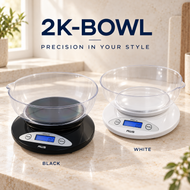
Best for Greater Precision: 2K-BOWL Digital Bowl Scale
The 2K-BOWL Digital Bowl Scale offers a 2,000-gram capacity with 0.1-gram readability. This makes it better suited to users who prioritize finer measurements over maximum capacity.
It includes a removable two-liter bowl, tare functionality, a backlit display and straightforward two-key operation. Measurements can be displayed in grams, ounces, troy ounces and pennyweight.
When 0.1-Gram Readability Is Helpful
A tenth-of-a-gram display can be useful when working with smaller quantities of ingredients. Examples may include:
-
Yeast
-
Salt
-
Spices
-
Tea leaves
-
Coffee beans
-
Recipe additives
-
Small portions
-
Ingredients used in test batches
Readability describes the smallest increment displayed by the scale. A readability of 0.1 gram means that the displayed weight changes in tenth-of-a-gram increments. This should not automatically be interpreted as laboratory-level accuracy, but it provides more detailed readings than a scale limited to whole grams.
For context, the gram is part of the International System of Units. The National Institute of Standards and Technology’s explanation of SI mass provides additional background on grams, kilograms and standardized mass measurement.
Capacity Is the Main Tradeoff
The 2K-BOWL can weigh up to 2,000 grams, or approximately 4.4 pounds. That is enough for many small and medium recipes, but it may not be sufficient for a heavy bowl filled with a large batch of dough.
Before selecting this model, consider the combined weight of the container and the largest recipe you expect to prepare. If that total may exceed 2,000 grams, a 5,000-gram model may be more practical.
Who Should Choose It?
The 2K-BOWL is well suited to bakers, coffee enthusiasts, hobbyists and home cooks who regularly measure smaller ingredient quantities and want 0.1-gram readability.
Best for a Large Expansion Bowl: LB-1000 Digital Bowl Scale
The LB-1000 Digital Bowl Scale is designed around a large expansion bowl and a 1,000-gram capacity with 0.1-gram readability.
Its removable bowl offers convenient holding space for loose ingredients, while the large LCD makes measurements easier to read. The model also includes calibration weights and an AC adapter, adding value for users who want a more complete weighing setup.
Why Included Calibration Weights Matter
Digital scales can be affected by transportation, handling, surface conditions and changes in the operating environment. Calibration allows a compatible scale to compare its reading against a known reference mass.
Not every kitchen task requires frequent calibration, but having the correct weights available can make it easier to check and maintain scale performance according to the manufacturer’s instructions.
Never substitute a random household object for a certified or specified calibration weight. Coins and packaged products may seem consistent, but wear, manufacturing variation and packaging differences can affect their actual mass.
Understanding the 1,000-Gram Limit
The LB-1000 provides precise 0.1-gram readings but has a lower maximum capacity than the 2K-BOWL and 5KBOWL. It is best used for small batches and individual ingredients rather than large mixing bowls filled with several pounds of food.
The expansion bowl offers physical volume, but the total mass placed on the scale must still remain within its rated capacity. Bowl size and weight capacity describe different characteristics and should not be confused.
Best Space-Saving Design: EXTEND-5K Collapsible Bowl Scale
Kitchen storage is often limited, particularly in apartments, small kitchens, recreational vehicles and shared living spaces. The EXTEND-5K Digital Kitchen Scale with Collapsible Bowl addresses that problem with a bowl designed to collapse when it is not being used.
The scale supports up to 5,000 grams or 11 pounds, giving it the capacity needed for general cooking, baking and meal preparation.
Benefits of a Collapsible Bowl
Traditional bowls occupy the same amount of cabinet space whether they are full or empty. A collapsible bowl reduces its stored height, helping the scale fit more easily into a drawer or cabinet.
This design may be especially useful for:
-
Small kitchens
-
Dorm rooms
-
RV kitchens
-
Vacation homes
-
Mobile food preparation
-
Occasional bakers
-
Cooks with limited cabinet space
A collapsible bowl also keeps the scale and container together. Users are less likely to misplace the bowl or select a separate container that blocks the display.
Who Should Choose It?
Choose a collapsible-bowl scale when you need useful capacity but do not want another bulky bowl taking up permanent kitchen space. It can be a practical compromise between a flat scale’s compact storage and a bowl scale’s ingredient control.
Best Stainless Steel Bowl Option: SAFFRON-5K-SS
Some users prefer stainless steel because it has a professional appearance and does not retain colors or odors as easily as certain other materials. The SAFFRON-5K-SS Digital Scale with Stainless Steel Bowl combines a 5-kilogram capacity with 1-gram readability and an included dishwasher-safe stainless steel bowl.
Its recessed platform allows the included bowl to fit securely while still giving users the option to weigh with another suitable container.
Why Choose a Stainless Steel Bowl?
A stainless steel bowl can be especially appealing for measuring:
-
Bread and pastry ingredients
-
Chopped fruit
-
Vegetables
-
Meat portions
-
Strongly colored spices
-
Aromatic ingredients
-
Dry mixes
-
Prepared foods
Stainless steel is also visually compatible with many modern kitchens. For people who leave their scale on the counter, appearance may be part of the buying decision.
Bowl Material Is Not the Only Consideration
Although material matters, it should not replace practical evaluation of capacity, readability and function. A beautiful bowl will not help if the scale cannot accommodate the total recipe weight or display the increment the user needs.
The best kitchen scale with a stainless steel bowl should still offer an easy-to-read display, intuitive tare control and a suitable weighing range.
Important Features to Compare
Maximum Capacity
Capacity is the greatest total weight the scale is designed to accept. It includes the bowl, plate or container and all ingredients placed inside it.
For example, placing a 700-gram bowl on a scale with a 2,000-gram limit leaves approximately 1,300 grams of available capacity for ingredients. Pressing tare changes the displayed number to zero, but it does not remove the bowl’s physical weight from the scale’s load cell.
Choose a capacity that provides a comfortable margin above your expected total. Regularly overloading a scale can damage its sensors and reduce performance.
Readability
Readability is the smallest change shown on the display. Common kitchen-scale options include 1 gram and 0.1 gram.
A 1-gram scale is usually suitable for flour, sugar, meat, produce, rice and complete meal portions. A 0.1-gram scale is more useful for smaller quantities where a whole gram represents a meaningful difference.
The required readability depends on the recipe. A one-gram difference is insignificant when measuring a kilogram of flour, but it may matter when measuring a small amount of yeast.
Accuracy, Readability and Precision
These terms are related but not identical.
Accuracy describes how close a measurement is to the true value. Readability describes the smallest increment displayed. Precision often refers to how consistently a scale reproduces a measurement under the same conditions.
A scale displaying 0.1 gram is not necessarily more accurate than every scale displaying 1 gram. Build quality, calibration, surface stability, load placement and operating conditions also influence results.
Independent kitchen-scale testing frequently evaluates accuracy, consistency, response time, display visibility and the effect of placing weight in different areas of the platform.
Tare Function
The tare function resets the displayed weight to zero after a container has been placed on the platform. This allows the scale to display only the weight of the ingredient added afterward.
Tare is one of the most valuable features on a food scale with a bowl. It can also allow several ingredients to be measured sequentially in the same container.
For example:
-
Place the empty bowl on the scale.
-
Press tare and wait for zero.
-
Add 300 grams of flour.
-
Press tare again.
-
Add 180 grams of water.
-
Press tare again.
-
Add the next ingredient.
This method can reduce the number of measuring cups and containers used during a recipe. However, keep track of each amount as you work. After taring, the previous ingredient’s weight is no longer shown.
Measurement Units
Many recipes use grams, while others use ounces, pounds, kilograms or fluid-volume measurements. A versatile kitchen scale should support the units most relevant to the user.
The NIST household weights and measures guidance can help users understand standardized measurement relationships, but remember that mass and volume are different properties. A fluid ounce is a unit of volume, while an ounce shown in a typical weighing mode represents mass.
Do not assume every liquid has the same relationship between milliliters and grams. Water is often treated as approximately one gram per milliliter in ordinary cooking, but oils, syrups and other liquids have different densities.
Display Visibility
Large bowls can cover a scale’s display. Look at the position of the screen and consider whether it remains visible when the included bowl or a larger container is used.
A backlit screen can improve readability in dim kitchens, under cabinets or when shadows from a large bowl fall across the display.
Bowl Capacity
Bowl capacity describes how much physical space is available, often expressed in liters. It is different from the scale’s weight capacity.
A lightweight bowl may hold a large volume of leafy vegetables without approaching the scale’s maximum weight. Conversely, a relatively small bowl filled with a dense ingredient could exceed the scale’s weight limit.
Consider both characteristics when comparing products.
Power Source
Battery-powered scales are portable and can be used wherever counter space is available. Models compatible with an AC adapter may be helpful for frequent or extended use.
If the scale uses batteries, keep replacements available and change weak batteries promptly. Low power can cause dim displays, inconsistent operation or error messages.
Ease of Cleaning
The removable bowl should be easy to wash, and the scale’s body should have accessible surfaces that can be wiped without forcing moisture into openings.
Review the product instructions before placing any component in a dishwasher. A bowl may be dishwasher safe even though the electronic base is not.
How to Use a Kitchen Scale With a Bowl
Step 1: Select a Stable Surface
Place the scale on a firm, level countertop. Soft, uneven or vibrating surfaces can interfere with measurements. Avoid placing the scale partly over a counter edge or on top of a towel.
Step 2: Turn On the Scale
Allow the display to initialize and show zero. If the scale displays an error, inspect the platform for pressure or excess weight and consult the product manual.
Step 3: Add the Empty Bowl
Place the bowl in the center of the weighing platform. Centered loading generally provides better stability and makes it less likely that the bowl will tilt or touch another object.
Step 4: Press Tare
Press the tare or zero button. The display should return to zero even though the bowl remains on the platform.
Step 5: Select the Correct Unit
Choose grams, ounces or the unit specified by the recipe. Grams are often convenient for baking because they avoid fractions and simplify scaling recipes up or down.
Step 6: Add Ingredients Gradually
Add the ingredient until the display reaches the target weight. When measuring a potent ingredient, approach the target slowly so you do not accidentally add too much.
Step 7: Record the Weight Before Taring Again
If you are adding several ingredients to the same bowl, confirm the measurement before pressing tare. Once the display resets, you may not be able to recover the previous amount.
Step 8: Stay Below Maximum Capacity
Remember that the bowl and all ingredients contribute to the total load even after the display has been tared. Stop if the scale displays an overload warning.
Using a Bowl Scale for Baking
Baking depends on ratios. Flour, water, fat, sugar and leavening ingredients interact to determine structure, texture, moisture and rise. Measuring ingredients by mass makes those ratios easier to reproduce.
Measuring Flour
Place the bowl on the scale, press tare and add flour until the required number of grams appears. There is no need to pack, scoop or level the flour.
This can be more repeatable than using cups because flour’s volume changes depending on how it is handled.
Measuring Water and Other Liquids
Liquids can be measured by mass when the recipe provides a weight. This is especially convenient for bread recipes written entirely in grams.
Do not automatically convert every milliliter to one gram. That approximation works reasonably well for water in everyday recipes, but ingredients with different densities require their own conversions.
Measuring Yeast, Salt and Spices
Small quantities require greater sensitivity. If a recipe calls for only a few grams of an ingredient, a scale with 0.1-gram readability may provide more useful resolution than a general kitchen scale that changes only in whole grams.
For extremely small or critical measurements, use an appropriately rated precision scale rather than assuming a high-capacity kitchen model can perform every task equally well.
Scaling a Recipe
Weight-based recipes are easy to multiply. To double a bread recipe containing 500 grams of flour and 350 grams of water, weigh 1,000 grams of flour and 700 grams of water.
This approach is cleaner than doubling several fractional cup measurements. It can also help bakeries and frequent home bakers achieve more consistent batch sizes.
Using a Kitchen Scale for Meal Prep
Meal prep often involves dividing a larger amount of food into several portions. A kitchen scale with a bowl can simplify both the initial preparation and the final distribution.
Portioning Cooked Food
First weigh the empty storage container and use tare. Add the desired amount of cooked rice, pasta, vegetables or protein. Repeat the process for each meal.
If the goal is to divide one prepared recipe evenly, weigh the entire finished recipe after subtracting the container weight. Divide that number by the desired number of portions.
For example, if the finished food weighs 2,400 grams and you want six equal servings, each serving should contain approximately 400 grams.
Using Reliable Nutrition Information
A scale measures mass; it does not independently determine calories or nutrient content unless it has a compatible nutritional database and calculation features.
For nutritional planning, use verified food information such as USDA FoodData Central. Pay attention to whether a database entry refers to raw food, cooked food or a specific branded product because the values may differ.
Understanding Serving Sizes
The serving size printed on a label is not necessarily a personalized recommendation. It is a standardized reference used to present nutrition information.
The FDA’s guide to serving sizes and portion sizes explains the distinction between the amount listed on a Nutrition Facts label and the amount a person chooses to eat.
A kitchen scale can show how much food is present, but personal dietary needs depend on factors beyond weight alone.
Planning Balanced Meals
A food scale is most helpful when used as an organizational tool rather than a source of stress. It can support consistent recipes, budgeting and portion awareness, but it does not replace nutritional variety.
The USDA MyPlate resources provide general information about building meals from different food groups. People with medical conditions or specialized nutritional needs should seek individualized guidance from a qualified professional.
Bowl Scale vs Flat Kitchen Scale
Both styles can be useful, and neither is automatically better for every person.
Choose a Bowl Scale If You:
-
Frequently weigh loose ingredients
-
Prepare baking mixtures
-
Want a container designed to fit the platform
-
Measure chopped produce or meal-prep ingredients
-
Prefer easier pouring and transfer
-
Want to reduce spills around the scale
-
Do not want to search for a separate bowl
Choose a Flat Scale If You:
-
Want the thinnest possible design
-
Mostly weigh plates and meal-prep containers
-
Prefer using your own mixing bowls
-
Need a broad, unobstructed platform
-
Want a scale that can be stored vertically
-
Regularly weigh items that do not fit inside a bowl
A removable-bowl scale can provide the benefits of both styles because the bowl can be taken off and the underlying platform used with another compatible container.
Common Kitchen Scale Mistakes
Ignoring the Container’s Weight
Tare makes the display show zero, but the physical bowl still counts toward the scale’s maximum capacity. A heavy container can substantially reduce the amount of food that may be added.
Measuring on an Uneven Surface
A digital scale should be used on a stable, level surface. Carpet, fabric, warped trays and unstable tables can contribute to inconsistent measurements.
Letting the Bowl Touch Another Object
If a large bowl touches a wall, appliance or utensil, part of its weight may be supported elsewhere. This can produce an incorrect reading.
Adding Ingredients Too Quickly
Scales need a moment to register changes. Add ingredients gradually, particularly as you approach the target weight.
Assuming More Decimal Places Always Mean Better Performance
Readability is important, but it is only one specification. Capacity, calibration, repeatability, construction and proper use also matter.
Overloading the Scale
Do not place more than the rated maximum on the platform. Overloading can damage the load cell even if it occurs only briefly.
Exposing the Scale to Water
A removable bowl may be washable, but most electronic kitchen scales should not be submerged. Wipe the base with an appropriate cloth and follow the care instructions.
Storing Heavy Items on the Platform
Do not use the scale as a permanent shelf. Continuous pressure can strain the weighing mechanism. Store it unloaded, with nothing pressing on the platform.
How to Check Kitchen Scale Performance
You can perform a basic consistency check by weighing the same appropriate reference item several times.
-
Place the scale on a level surface.
-
Turn it on and allow it to reach zero.
-
Place the item in the center.
-
Record the reading.
-
Remove the item and allow the scale to return to zero.
-
Repeat the measurement several times.
The readings should be reasonably consistent within the scale’s specifications. This does not replace professional calibration or certification, but it can reveal obvious instability.
If the numbers drift, check the batteries, surface, room conditions and placement of the load. Calibrate only according to the manual and use the specified calibration mass.
Which Bowl Scale Should You Buy?
Choose according to the jobs you perform most often.
Choose a 5,000-Gram Bowl Scale When:
-
You prepare large recipes
-
You weigh bread dough
-
You divide family-size meals
-
You use relatively heavy containers
-
Whole-gram readability is sufficient
-
Capacity is more important than fractional-gram detail
Choose a 2,000-Gram, 0.1-Gram Scale When:
-
You prepare smaller batches
-
You measure ingredients requiring finer resolution
-
You weigh coffee, spices or yeast
-
You want tenths-of-a-gram readings
-
Your bowl and ingredients remain below the capacity limit
Choose a 1,000-Gram Precision Bowl Scale When:
-
Most measurements are small
-
You prioritize 0.1-gram readability
-
You want an expansion bowl
-
You value included calibration accessories
-
You do not need to weigh large batches
Choose a Collapsible Bowl When:
-
Storage space is limited
-
You want an included container
-
You need an 11-pound capacity
-
You travel or cook in multiple locations
-
You prefer a bowl that stores more compactly
Choose Stainless Steel When:
-
You want a professional-looking bowl
-
You work with aromatic or strongly colored foods
-
Easy bowl cleanup is a priority
-
You prefer stainless steel kitchen accessories
-
You need a versatile 5-kilogram capacity
Frequently Asked Questions
Is a Kitchen Scale With a Bowl Better?
It is better for users who frequently weigh loose, wet or irregularly shaped ingredients. The bowl keeps food contained and can make transfer and cleanup easier. A removable-bowl model also allows the platform to be used separately.
What Capacity Is Best for a Kitchen Scale?
A capacity of approximately 5 kilograms or 11 pounds is versatile for general home cooking, baking and meal prep. A lower-capacity model may be preferable when finer readability is more important than weighing large batches.
Is 1-Gram Readability Accurate Enough for Baking?
One-gram readability is suitable for many baking ingredients, including flour, sugar, water and butter. Ingredients used in very small amounts, such as yeast or certain additives, may be easier to measure with 0.1-gram readability.
Can I Put My Own Bowl on a Kitchen Scale?
Yes, provided the bowl fits securely, does not block the controls or touch surrounding objects, and does not cause the combined load to exceed the scale’s maximum capacity. Place the bowl on the platform and press tare before adding ingredients.
Does Tare Remove the Bowl’s Weight From the Capacity?
No. Tare removes the bowl’s weight from the displayed result, but the scale still physically supports that weight. The bowl and ingredients together must remain below the maximum capacity.
Can I Measure Liquids on a Kitchen Scale?
Yes, when the recipe specifies liquid weight or when you have a reliable density-based conversion. Do not assume every milliliter of every liquid equals one gram.
Can a Kitchen Scale Calculate Calories?
A standard kitchen scale only measures weight. Calories must be calculated using accurate nutrition information for the particular food and its measured quantity. Nutritional scales may include databases or calculation tools, but the selected food entry and serving condition must still be correct.
How Often Should a Kitchen Scale Be Calibrated?
Follow the manufacturer’s instructions. Calibration may be appropriate when the scale is new, has been transported, gives inconsistent readings or fails a check with the correct reference weight. Only use the calibration mass specified for the model.
Why Does My Kitchen Scale Keep Changing?
Possible causes include an uneven surface, vibration, air movement, low batteries, temperature changes, an off-center load or a bowl touching another object. Move the scale to a stable surface and repeat the measurement.
Can a Kitchen Scale Be Used for Shipping Packages?
Some kitchen scales can weigh lightweight packages that fit within their rated capacity and platform area. However, a dedicated shipping scale is usually better for larger boxes because it offers a higher capacity and a platform designed for packages.
What Is the Best Bowl Material?
The best material depends on personal preference. Plastic bowls are lightweight and practical. Stainless steel bowls offer a professional appearance and resist many stains and odors. Collapsible bowls save storage space. Always review the care instructions for the particular bowl.
Final Verdict: Finding the Best Kitchen Scale With a Bowl
The best kitchen scale with a bowl should match the size and precision of the recipes you prepare.
For everyday cooking, large recipes and meal prep, a 5,000-gram model with 1-gram readability offers a useful combination of capacity and simplicity. For smaller ingredients and more detailed measurements, a 2,000-gram or 1,000-gram scale with 0.1-gram readability may be the better choice.
The bowl itself should be removable, stable and easy to clean. The scale should also provide a clear display, a convenient tare function, appropriate measurement units and enough capacity for both the container and its contents.
A well-chosen digital kitchen scale can reduce guesswork, improve recipe consistency and simplify portioning. Instead of relying on how tightly an ingredient fits into a cup or whether two servings look equal, you can work with a clear numerical measurement.
Whether you are baking bread, portioning weekly meals, measuring coffee or preparing a family recipe, the right kitchen scale with a bowl can become one of the most frequently used tools on your counter.