
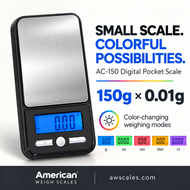
Best Pocket Scale Assortment for Retailers
Published by AWS Team on 26th Oct 2026
A customer looking for a pocket scale usually has a specific task in mind. They might want to weigh small jewelry components, organize hobby materials, or carry a compact scale in a toolkit. A useful retail assortment helps them find a suitable model without having to sort through a shelf of confusing specifications.
The best pocket scale assortment covers distinct capacity and readability needs, offers a clear range of features, and makes it easy for shoppers to compare models. Start with a manageable selection, explain what each scale is designed to do, and use customer questions and sales data to guide your next order.
American Weigh Scales offers a range of digital pocket scales retailers can evaluate for different audiences. Confirm current availability and wholesale terms before placing an order.
What Should a Pocket Scale Assortment Include?
A retailer does not necessarily need every capacity and design. The goal is to offer meaningful choices.
| Assortment Position | Customer Need | What to Compare |
|---|---|---|
| Compact small-item scale | A portable scale for lighter objects | Capacity, readability, platform, and cover |
| General-purpose pocket scale | More capacity for larger portions | Maximum load, tare, and measurement units |
| Covered travel scale | Storage in a bag or toolkit | Protective cover and overall dimensions |
| Fine-readability model | A smaller displayed increment | Capacity, readability, and operating requirements |
| Feature-focused model | A particular workflow or preference | Verified features and included accessories |
Before adding a model, ask: What customer need does this scale serve that the others do not?
Start with Capacity and Readability
Two numbers appear prominently on many scale listings: capacity and readability.
Capacity
Capacity is the maximum load the scale can weigh.
Remind customers to include the weight of any container or tray when considering the full load. Using the tare function does not increase the scale’s maximum capacity.
Readability
Readability is the smallest increment shown on the display.
For example:
- 220 g × 0.01 g: A maximum capacity of 220 grams and a displayed increment of 0.01 grams.
- 600 g × 0.1 g: A maximum capacity of 600 grams and a displayed increment of 0.1 grams.
Readability is not the same as guaranteed accuracy. Customers should review the model’s specifications, calibration instructions, and suitability for the intended task.
The NIST weighing and scales FAQs explain how intended loads and usage affect scale selection. www.nist.gov
Pocket Scale Models to Consider for Your Store
The following models illustrate different positions in an assortment. Confirm current availability, specifications, and wholesale pricing before ordering.
AWS-220: A Compact 220 g × 0.01 g Option
The AWS-220 digital pocket scale is listed with 220 g capacity and 0.01 g readability. Its listing includes grams, ounces, carats, and grains, along with two AAA batteries. AWScales
It gives retailers a compact option for shoppers whose items and containers fit within that capacity.
Merchandising angle: Show the capacity and increment together, and explain the included measurement units.
AWS-600: More Capacity in a Pocket Format
The AWS-600 digital pocket scale series is listed at 600 g × 0.1 g. It provides a comparison point for shoppers who need more capacity than a smaller model offers. awscales.com
Merchandising angle: Position it beside a lower-capacity model so customers can see the tradeoff between maximum load and displayed increment.
CARDV2-200: A Compact Small-Item Scale
The CARDV2-200 is listed with 200 g capacity and 0.01 g readability. Its compact format can appeal to shoppers who prioritize easy storage. awscales.com
Merchandising angle: Highlight the dimensions and platform size so customers can decide whether their items will fit comfortably.
GEMINI-50: A Fine-Readability Option
The GEMINI-50 precision milligram scale is listed at 50 g × 0.001 g. It offers a finer displayed increment and a lower capacity than many general-purpose pocket models. AWScales
Customers considering milligram readability should review the operating instructions and select a scale appropriate to their application. Display increments do not, by themselves, guarantee accuracy at every load.
Availability: Check current stock with American Weigh Scales before promoting or ordering this model.
A Simple Opening Assortment
For a store introducing the category, a starting assortment could include:
- One compact model with a 0.01 g displayed increment.
- One model with greater capacity, such as a 600 g option.
- One portable model with a protective cover.
- One fine-readability model if customer demand supports it.
You may not need all four immediately. A store serving jewelers may receive different questions from a general gift shop or hobby retailer.
Start with models that match your shoppers, then review sell-through and feedback before expanding.
Features That Help Customers Choose
Tare Function
Tare lets users account for a container’s weight when viewing the net weight of its contents.
NIST’s weighing and scales FAQs explain the function and its relationship to gross and net weight. www.nist.gov
Confirm the feature on each model and remind customers that the container still counts toward maximum capacity.
Measurement Units
Some customers want grams; others may use ounces, carats, or grains. Check the exact units on each product rather than assuming the entire range is identical.
Protective Cover
A cover can appeal to customers who carry a scale or store it between uses. Confirm whether it is included and how it fits on the model.
Display and Controls
A readable display and straightforward controls can make a product easier to demonstrate. If you advertise a particular display mode or color, verify that feature on the specific model.
Included Accessories
Make it clear whether batteries, trays, calibration weights, or cases are included. Package contents can be an important difference between models.
Stock Calibration Accessories Where Appropriate
Customers may need a specific calibration weight to adjust their scale according to the manufacturer’s instructions.
Check:
- Whether the model supports user calibration.
- Which weight is specified.
- Whether that weight is included.
- Whether your store stocks a compatible weight.
American Weigh Scales’ product manuals provide instructions for many models and can help staff answer these questions. awscales.com
Avoid suggesting one calibration weight for every model. Requirements vary.
Make the Assortment Easy to Understand
A simple shelf card can help shoppers compare products:
Model: AWS-220
Maximum capacity: 220 g
Displayed increment: 0.01 g
Units: Grams, ounces, carats, and grains
Included: Check the current product listing and packaging
Place models in a logical order, such as increasing capacity, and keep the same information in the same position on every card.
For ecommerce listings, use the same comparison fields so shoppers do not have to search through several descriptions.
Avoid Confusing “Precise” with “Legal for Trade”
Some customers may ask whether they can use a scale to determine the price or quantity of goods in a commercial transaction.
Do not assume that a pocket scale is approved for that purpose.
NIST explains that commercial weighing devices must comply with applicable state requirements and may need inspection and approval before use. www.nist.gov
The National Type Evaluation Program overview explains type evaluation for weighing devices. Verify the specific model’s approvals and direct customers to the relevant state or local weights-and-measures authority for their intended use. www.nist.gov
Evaluate Wholesale Terms Before Setting Prices
A product’s retail price is not the same as your landed cost.
Ask your supplier about:
- Current wholesale pricing.
- Minimum quantities or order values.
- Mixed-model ordering.
- Available colors.
- Shipping costs and lead times.
- Warranty and return procedures.
- Product images and retailer materials.
American Weigh Scales offers a dealer application where retailers can inquire about becoming an AWS dealer. Confirm current terms for your order. awscales.com
Calculate Margin Using Your Landed Cost
Include the costs required to get the product onto your shelf.
For a simplified example:
- Hypothetical landed cost: $15
- Hypothetical retail price: $30
- Gross profit: $15
- Gross margin: 50%
The calculation is:
(Retail price − landed cost) ÷ retail price
This example excludes other business expenses. Use your actual quote, shipping, fees, and expected returns to assess pricing.
Track More Than Sales
After the first order, review:
- Which capacities sell fastest.
- Which products customers compare.
- Common questions about calibration or units.
- Whether shoppers ask for included accessories.
- Return reasons.
- Requests for different designs or colors.
A slow-selling scale may need clearer positioning—or it may not fit your customer base. Use the evidence to adjust the assortment.
Common Retail Assortment Mistakes
Carrying Several Nearly Identical Models
Make sure each listing has a clear reason to be there.
Promising Accuracy from Readability Alone
A display increment describes what the scale shows, not a complete accuracy guarantee.
Forgetting Container Weight
The container and contents both count toward the maximum load.
Assuming Accessories Are Included
Check the product page and current retail package.
Making Unverified Legal-for-Trade Claims
Confirm model-specific approvals and applicable local requirements.
Ordering Too Much Before Testing Demand
Begin with quantities informed by your shoppers and reorder based on results.
Frequently Asked Questions
How many pocket scale models should a retailer carry?
There is no universal number. Start with enough models to address distinct customer needs without making comparison difficult.
What does 0.01 g readability mean?
It means the display changes in increments of 0.01 g. It is not, by itself, a guarantee of accuracy.
Should I stock both 0.01 g and 0.1 g scales?
That can help you offer different capacity and readability combinations, provided those options match your customers’ needs.
Do all pocket scales include calibration weights?
Do not assume so. Check the specific model’s listing and manual.
Can a pocket scale be used for commercial transactions?
The answer depends on the specific model, intended use, and jurisdiction. Verify required approvals and consult the relevant weights-and-measures authority.
How can I inquire about wholesale ordering?
Use the American Weigh Scales dealer application or contact the company to discuss current pricing, availability, and order requirements.
Build an Assortment Customers Can Compare
The best pocket scale selection makes the differences clear: capacity, readability, portability, and verified features.
Choose models for distinct customer needs, explain the specifications consistently, and refine your selection using actual sales and feedback. To discuss current wholesale options, contact American Weigh Scales with the models and quantities you are considering.