
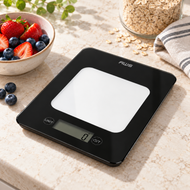
Best Scale Assortment for Bakeries
Published by AWS Team on 22nd Oct 2026
The best scale assortment for bakeries covers three main jobs: measuring smaller ingredients, preparing larger batches and portioning products. Add equipment for commercial sales or packaged-product checks according to the requirements of those applications.
A useful assortment gives each scale a clear purpose. Buying several similar models can increase training and inventory costs without improving your production process.
Start with the quantities you weigh, the containers you use and the variation your recipes can accept. Then choose equipment that fits each station and verify its performance before placing a larger order.
For bakeries that also sell baking tools, plan retail inventory separately from operational equipment.
Build the Assortment Around Your Workflow
Map the tasks performed during a normal production day.
| Weighing role | Typical requirement | Selection priority |
|---|---|---|
| Small ingredients | Measuring smaller recipe additions | Suitable readability and verified performance |
| General preparation | Weighing ingredients into bowls | Capacity, tare and container fit |
| Dough portioning | Repeated individual portions | Response, repeatability and cleaning |
| Larger batches | Heavy bowls and ingredients | Full-load capacity and platform dimensions |
| Packaged-product checks | Verifying net contents | Appropriate equipment and checking procedure |
| Retail resale | Supporting home baking | Clear specifications and customer support |
Count how many employees need to weigh at the same time. One suitable scale may still be insufficient when several stations compete for it.
Position equipment where the work happens so staff do not need to carry ingredients across the bakery unnecessarily.
1. Choose a Core Preparation Scale
A core preparation model should handle the bowls and ingredient quantities used most often.
Review wholesale kitchen scales as candidates, checking the exact model’s specifications and intended operating conditions.
Useful features to evaluate include:
-
Capacity for the complete bowl and ingredients.
-
Readability appropriate to the recipe.
-
Accessible tare controls.
-
A display visible beneath the bowl.
-
Suitable response during additions.
-
Automatic shutoff behavior.
-
A cleaning method compatible with the station.
Test your actual containers. A platform can support the load numerically while leaving the bowl unstable or blocking the screen.
Choose one core model where it meets the needs of several stations. Standardization can simplify training, provided the product fits each assigned task.
2. Add a Small-Ingredient Option Where Needed
Smaller additions may require different equipment from larger recipe batches.
Selected pocket scales may be candidates when their capacity, platform and checked performance suit the application.
Use an appropriate container and confirm cleaning limitations. A compact housing is not automatically suitable for direct food contact or a flour-heavy environment.
Define the smallest quantity and acceptable variation before selecting readability.
A hypothetical 0.5g difference represents 10% of a 5g quantity but only 0.1% of a 500g quantity. This illustrates why small additions deserve separate evaluation; it does not describe a particular scale’s error.
The NIST mass-units reference explains grams and related metric units. Use consistent units in recipe sheets, equipment labels and training materials.
More decimal places alone do not establish accuracy or the smallest reliably measurable quantity.
3. Select a Portioning Scale for Repeated Work
A portioning station needs equipment that responds consistently to loading, adjustment and unloading.
Test the scale with the intended dough, tray or suitable food-contact barrier. Confirm that the arrangement does not touch another support or interfere with the platform.
Evaluate:
| Test | What to observe |
|---|---|
| Place a portion | Time needed for a usable indication |
| Add or remove material | Response near the target |
| Remove the portion | Return to zero |
| Repeat loading | Variation between readings |
| Use the normal tray | Display visibility and stability |
| Clean after the trial | Practicality of the approved method |
Choose acceptable portion variation through your production process, then assess whether the scale supports that decision.
Avoid cutting or pressing dough on the platform unless the manufacturer explicitly permits the activity. Those actions can apply forces beyond ordinary weighing.
A core preparation model may also serve portioning if it passes both evaluations.
4. Include a Larger-Capacity Production Model
Review bench scales for heavier bowls, larger batches and suitable production loads.
Check the exact capacity and platform dimensions against the complete setup.
For example:
| Hypothetical container | Contents | Combined load |
|---|---|---|
| 600g | 2,000g | 2,600g |
| 1,500g | 4,000g | 5,500g |
| 2,500g | 12,000g | 14,500g |
These examples illustrate capacity planning, not product performance.
Tare changes the displayed result while the container remains on the sensor. Leave practical headroom for different containers and normal batch changes.
Some production loads will exceed the range of a particular bench scale. Select equipment against the actual requirement rather than assuming every model in the category can handle it.
5. Consider Bowl Scales When the Format Helps
Selected bowl scales can offer a convenient format for contained ingredients.
Evaluate the bowl’s usable volume, stability, pouring behavior and cleaning instructions. Confirm suitability for the intended food-contact use.
Capacity and volume are separate constraints. A bulky ingredient can fill a bowl before reaching the scale’s mass limit.
Add this format when it improves handling. If your existing containers already work well with a preparation scale, a separate bowl model may duplicate the same role.
Keep Packaging and Sales Equipment Separate
Recipe preparation, commercial transactions and packaged-quantity verification involve different requirements.
Before using a scale to determine a selling price by weight, verify the exact model and applicable local requirements.
The NIST weighing and scales FAQs provide background on commercial weighing. Fine readability and a calibration function do not establish legal-for-trade suitability.
For packaged products, establish how net contents are checked and how packaging tare and variation are handled.
NIST’s packaging and labeling resources provide background on package quantity and labeling practices. Select equipment alongside the procedure that applies to your products.
Do not treat a general preparation-scale purchase as proof that these separate needs have been covered.
Use a Practical Operational Starting Mix
Determine quantities from simultaneous use and the consequences of downtime.
The following is a hypothetical equipment plan for a small bakery, not an industry benchmark:
| Equipment role | Illustrative quantity |
|---|---|
| Core preparation scales | 2 |
| Small-ingredient scale | 1 |
| Portioning scale | 1 |
| Larger batch scale | 1 |
| Checked backup for a critical task | 1 |
A core model might cover more than one role at different times. A busier bakery may need dedicated units to avoid queues.
Validate the backup against its assigned task. A compact spare cannot replace a production scale if it lacks the required capacity.
Keep equipment for packaging or transactions as a separately verified line item.
Plan Retail Stock Around Home Bakers
If your bakery sells tools, begin with products that suit your customers’ home setups.
A focused retail assortment might include a core preparation scale and one clearly differentiated alternative, such as a compact model or a larger-capacity option.
Explain the differences through capacity, readability, platform size and included components.
Avoid presenting production equipment as an automatic upgrade for every home baker. Larger equipment may take more storage space without offering a useful benefit for that customer.
Start with modest quantities when demand is unproven. Keep demonstration units separate from saleable stock.
Evaluate Samples Before Standardizing
Write acceptance criteria for each role before ordering multiple units.
Use suitable reference weights near normal working loads. Repeat measurements, check zero return and observe behavior with the intended containers.
NIST’s calibration overview explains relating instrument response to reference standards. Follow the exact model’s instructions for any adjustment routine.
Then run the complete workflow. Include preparation pauses, additions, unloading and cleaning.
Record the approved model and its limitations. This helps prevent later substitutions that look similar but do not meet the same requirements.
Plan Accessories and Reference Weights
Review weighing scale accessories and confirm availability and compatibility.
Check batteries, adapters and calibration-weight requirements. Identify which items are included before ordering duplicates.
Where documented traceability is required, specify the evidence needed before purchasing reference equipment.
NIST’s metrological traceability guidance explains the documented calibration chain connecting measurement results to a reference. A nominal marking on a weight does not establish that chain.
Store reference weights where they remain protected from residue, moisture and damage.
Make Cleaning and Routine Checks Part of the Assortment Decision
Choose equipment that your bakery can maintain appropriately.
Follow the manufacturer’s cleaning instructions. A stainless-steel platform does not establish that the housing can be washed down.
Assess how residue collects around controls and platform gaps. Confirm that approved cleaning methods fit your sanitation and allergen-control procedures.
Assign responsibility for reference checks and keep records for operational units.
NIST’s guidance on controlling calibration results discusses monitoring short-term and long-term measurement variation. Use recorded checks to identify changes needing investigation.
Check equipment after relevant changes, movement or suspected damage according to your procedure.
Compare Cost Across the Equipment’s Working Life
Consider purchase price alongside training, cleaning time, downtime and replacement arrangements.
For retail inventory, calculate landed cost and contribution after direct selling costs. Review returns and recurring support questions by model.
A cheaper product that repeatedly interrupts production may cost more overall. A specialty retail model can tie up cash when it has no clear customer audience.
Request exact specifications, quantities, included components, freight charges and support terms in your wholesale quotation.
Expand the assortment when a new role or demonstrated demand justifies it.
Frequently Asked Questions
What is the best starting scale assortment for a bakery?
Cover general preparation, smaller ingredients and portioning first, adding larger-capacity equipment where batch loads require it. Verify packaging and transaction needs separately.
Does every station need a different model?
No. One model can serve several roles if it meets their capacity, performance, handling and cleaning requirements.
Should bakeries buy the finest readability available?
Choose readability according to recipe quantities and acceptable variation, then verify performance. Additional decimal places alone do not establish suitability.
Do bowls and trays count toward capacity?
Yes. Their physical load remains after the display is tared.
Should a bakery keep a backup scale?
Consider the effect of downtime. Any backup should be checked and suitable for the task it may replace.
Build Your Bakery Scale Assortment
Assign each scale a defined role, test it in the intended workflow and set quantities around actual use. Keep retail demand and operational equipment needs separate when planning the order.
Explore American Weigh Wholesale to compare available categories and request current specifications, pricing and ordering terms. The site advertises volume pricing and reseller support; confirm the details for your proposed purchase.