
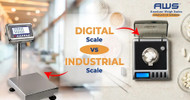
Digital Scale vs Industrial Scale: Which One Is Right for Your Business?
26th Jun 2026
Whether you operate a retail store, its warehouse, a manufacturing facility, a laboratory, or a shipping activity, the selection of the appropriate weighing equipment has a direct influence on the accuracy, efficiency, and compliance. Among the most wide-spread questions, which businesses have, is the question How to choose between a digital scale and an industrial scale?
The solution is based on your weighing needs, capacity requirements, environment of use and its intended use. The two choices are both supposed to give the correct measurements, but they suit different purposes.
In this guide, we check the digital scales vs industrial scales, answer their main differences and assist you to identify the best solution, to meet the needs of your business.
Understanding Digital Scales
Digital scale Digital scale is an electronic weighing scale, which relies on sensors and digital displays to show accurate weights. The scales are also highly prevalent in retail, food service, laboratories and jewel stores as well as shipping centers among others.
Digital scales are characterized by convenience, portability and high measurement accuracy with use on light loads.
Common Applications of Digital Scales
Digital scales are commonly used for:
- Retail product weighing
- Jewelry and precious metal measurement
- Kitchen and food preparation
- Postal and shipping calculations
- Laboratory testing
- Cannabis and specialty product weighing
Most of the digital scales are made in low and medium capacity weighing and give very accurate values in grams, ounces, pounds or kilograms.
Understanding Industrial Scales
An industrial scale is a heavy rig weighing machine, meant to handle large weights, harsh conditions, and is a permanent load. These scales are prevalent in warehouses, manufacturing facilities, logistics, and construction areas, and industrial premises.
Scales used in industries focus on functionality, durability and large capacity operation at reliable accuracy in harsh environments.
Common Applications of Industrial Scales
The industrial scales are commonly used in the case of:
- Pallet weighing
- Inventory management
- Freight and logistics operations
- Manufacturing processes
- Raw material measurement
- Heavy equipment weighing
These scales have the potential to accommodate much bigger loads compared to regular digital scales, and are required in industry.
Digital Scale vs Industrial Scale: Key Differences
The main distinction between a digital scale and an industrial scale is the purpose they are used and the weight capacity.
| Feature | Digital Scale | Industrial Scale |
|---|---|---|
| Capacity | Low to Medium | Medium to Extremely High |
| Accuracy | Very High for Small Loads | High for Large Loads |
| Portability | Lightweight and Portable | Usually Stationary |
| Durability | Standard Commercial Use | Heavy-Duty Construction |
| Environment | Indoor and Controlled Areas | Harsh Industrial Settings |
| Cost | Generally More Affordable | Higher Initial Investment |
| Applications | Retail, Labs, Food Service | Manufacturing, Warehousing, Logistics |
Businesses should evaluate their operational requirements before selecting a scale type.
When Should You Choose a Digital Scale?
The scale should be digital when it is needed that the small things are measured and daily business activities need to be carried out.
Digital Scales Are Ideal If You Need:
- High precision for lightweight products
- Portable weighing equipment
- Compact storage solutions
- Affordable weighing systems
- Retail or laboratory-grade measurements
An example is a jewelry store that will measure precious metals or a shipping business weighing small packages they will do well with a digital scale compared to a large industrial platform scale.
Benefits of Digital Scales
Digital scales have a number of benefits:
- Fast and accurate readings
- User-friendly interfaces
- Compact design
- Multiple measurement units
- Lower maintenance requirements
These advantages have made digital scales an attractive scale in most fields.
When Should You Choose an Industrial Scale?
The reason behind the need of industrial scales lies in the high weight of the objects of operation, the large size of the inventory process, or the harsh working conditions.
Industrial Scales Are Ideal If You Need:
- High-capacity weight measurement
- Continuous operation throughout the day
- Rugged equipment for industrial environments
- Pallet and freight weighing
- Inventory and warehouse management
To illustrate, a warehouse with hundreds of pallets a day will need an industrial floor scale that is capable of withstanding heavy weight without affecting precision.
Benefits of Industrial Scales
Industrial scales provide:
- Exceptional durability
- High load capacities
- Long operational lifespan
- Reliable performance in harsh conditions
- Improved efficiency for large-scale operations
Such benefits make it worth investing to business ventures dealing with heavy materials on a regular basis.
Factors to Consider Before Buying
The following are questions that one should consider before buying either a digital scale or industrial scale:
1. Weight Capacity
Determine the highest weight you are going to weigh. Using a scale that has an inadequate capacity may result in inaccuracy in results and the damage of equipment.
2. Accuracy Requirements
Due to its industry applications, e.g. jewelry, pharmaceuticals, laboratories, etc. industries require a greater degree of precision than warehouse applications.
3. Operating Environment
Scales are usually subjected to dust and moisture in industrial facilities, vibration, and temperature changes. Select equipment that is suited to such conditions.
4. Frequency of Use
Once continuously weighing businesses require more robust equipment compared to a business that uses scales only infrequently.
5. Budget and Long-Term Value
Many scales used in industries are normally more expensive initially, but in the long run they are usually more durable and fewer replacement expenses.
Final Thoughts
The dilemma of deciding which one to choose between a digital and an industrial scale is dependent on your particular business needs. A digital scale will probably be the most suitable option should you be required of highly precise measurements of smaller products. An industrial scale is durable and powerful; it will provide you with the power and capacity needed especially in your operation that entails heavy loads, warehouse management or manufacturing process.
When the appropriate weighing solution is invested in, the efficiency of operations, accuracy in measurement and efficiency will be enhanced. With proper analysis of your capacity, environment and application needs, you can choose a scale, which can sustain your business even over the long term.
American Weigh Wholesale is a company that provides wholesale weighing systems that are highly sought after by companies aiming to introduce their business products to the market and also those companies that require these scales in their commercial and industrial use.
FAQs
1. What is the main difference between a digital scale and an industrial scale?
Digital scales are constructed to carry lighter weights and to be very precise whereas industrial scales are constructed to carry heavier weights and extreme conditions.
2. Are industrial scales digital?
Yes. Majority of the current industrial scales are digital and have more powerful platforms, large capacity and industrial grade components.
3. Which scale is more accurate?
Digital scales can give more accuracy of small items, whereas industrial scales are very accurate when it comes to heavy loads.
4. Can a digital scale be used in a warehouse?
The package weighing can be performed with a small digital scale, but it is common in the world of package handling to have industrial floor or pallet scales used when dealing with large loads.
5. How do I choose the right scale for my business?
Some of the factors to be considered when choosing a digital scale or industrial scale include weight capacity, accuracy, operating conditions, frequency of use, and budget.