
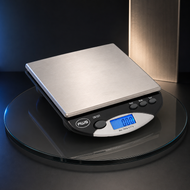
How Coffee Roasters Can Merchandise Digital Scales for Better Sell-Through
Published by AWS Team on 22nd Oct 2026
Coffee roasters can make digital scales easier to sell by showing customers how they fit into a familiar brewing routine. Place a suitable scale beside the equipment it supports, demonstrate a simple recipe and explain the specifications that affect everyday use.
A boxed scale with an unfamiliar model number gives shoppers little context. A working display with a dosing cup or brewing vessel helps them understand what the product does and whether it fits their setup.
Effective merchandising also sets accurate expectations. Customers need to know the scale’s capacity, readability, included features and care requirements before purchasing.
This guide explains how to organize your display, prepare useful demonstrations and measure whether your changes support better sell-through.
Start With the Customer’s Brewing Setup
Organize your offer around the way customers prepare coffee.
Someone measuring dry beans before grinding has different requirements from someone placing an entire brewing assembly on the platform.
| Customer task | What to demonstrate | What to confirm |
|---|---|---|
| Weighing a coffee dose | Cup plus dry beans | Readability, capacity and platform fit |
| Brewing into a server | Complete brewing assembly | Total load, display visibility and response |
| Preparing larger quantities | Larger vessel and intended contents | Capacity and usable platform area |
| Traveling with coffee equipment | Compact setup and storage | Protection, dimensions and power |
| Learning a recipe | Measuring coffee and water | Controls, unit selection and instructions |
Ask a few practical questions during the sale: what vessel the customer uses, how much they usually brew and whether they need a timer.
These answers help staff recommend a suitable product without making the customer interpret every specification alone.
Give Each Displayed Model a Clear Role
A focused selection is easier to explain than several nearly identical models.
Choose a primary option, then add alternatives only when they solve a different problem.
Review wholesale kitchen scales as candidates for preparation and brewing applications. Verify each model’s capabilities before describing it as suitable for a particular setup.
A useful display might include:
-
A core preparation scale for everyday home use.
-
A compact model for smaller dry-coffee loads.
-
A larger-capacity option for heavier vessels.
Selected pocket scales may serve the compact role when the complete load fits. Check the platform with the intended dosing cup.
Avoid labeling models “good,” “better” and “best” when their real differences concern capacity or format. “Compact dosing” and “larger brewing setup” give customers more useful information.
Position Scales Beside Relevant Equipment
Place the display where customers already consider home brewing.
Good locations include a brewing-equipment shelf, the area used for classes or a dedicated accessories section near packaged coffee.
Keep the display clear of busy drink preparation areas. A demonstration scale needs a stable surface, room for the vessel and a screen customers can see.
A small sign can introduce the benefit plainly:
Start with a measured dose. Choose a scale that fits your brewing setup.
Use the actual product in the display, with packaged stock nearby. Make the selling price visible so customers can evaluate the purchase without needing to ask.
For larger equipment, keep a comparison card or sample available by request if shelf space is limited.
Make Specifications Easy to Compare
Use the same shelf-label format for every scale.
| Label field | Information to display |
|---|---|
| Maximum capacity | Total supported load |
| Readability | Smallest displayed increment |
| Platform dimensions | Space available for the vessel |
| Timer | Included only if verified |
| Power | Battery, charging or adapter requirements |
| Package contents | Confirmed included items |
| Care | Relevant manufacturer instructions |
| Price | Clear retail selling price |
Show capacity and readability together. Customers need both to judge fit.
Explain Readability Without Overstating Accuracy
A scale displaying 0.1g increments shows tenths of a gram. That does not establish that every reading is accurate within 0.1g.
The NIST mass-units reference provides background on grams and related metric units. Use consistent unit notation across signs, recipes and product pages.
Explain readability as the display increment. Accuracy and repeatability require separate evaluation.
Avoid unsupported labels such as “perfectly accurate,” “professional precision” or “guaranteed better coffee.” Describe verified features and show how the customer can use them.
The FTC’s advertising guidance for small businesses explains the need for truthful, nondeceptive advertising backed by evidence. Apply that principle to shelf cards, online listings and staff recommendations.
Demonstrate One Simple Recipe
A short demonstration should help customers understand normal operation.
Use a store-owned vessel and a recipe your team has selected. Make clear that the recipe is a starting point rather than a guarantee of a particular flavor.
For example, a hypothetical demonstration could use 20g of coffee and 320g of water, a 1:16 coffee-to-water mass ratio.
Show the customer how to:
-
Place the scale on a firm, stable surface.
-
Confirm that grams are selected.
-
Position the vessel securely.
-
Tare according to the intended recipe sequence.
-
Add material while watching the display.
-
Read the result after the indication settles.
If the model has no timer, demonstrate the separate timer used with it. Do not imply a feature is built in when it is not.
Keep water away from equipment unless its manufacturer permits the intended exposure. A dry-coffee demonstration can explain the controls when a wet demonstration is unsuitable.
Explain Capacity With the Complete Brewing Assembly
Show customers that capacity includes everything on the platform.
A server, dripper, filter, coffee and water all contribute to the physical load.
Consider this hypothetical example:
| Component | Mass |
|---|---|
| Server and dripper | 650g |
| Filter and dry coffee | 30g |
| Water added during the process | 500g |
| Maximum combined load in this example | 1,180g |
Taring the display does not remove the equipment’s weight from the sensor.
Check the heaviest point in the customer’s actual process and leave practical headroom. Also confirm that the vessel does not block the screen or touch another support.
A brief explanation at purchase can prevent a customer from choosing a compact product that cannot accommodate their full setup.
Show Larger Formats Only Where They Help
Some customers need a larger container or platform rather than a smaller display increment.
Review bowl scales for suitable contained-load preparation tasks. Demonstrate how the container handles the intended quantity, and confirm food-contact suitability and cleaning instructions.
For heavier loads, compare bench scales against the customer’s full load and space requirements.
Keep these models relevant to the audience. A production-oriented format does not need prominent retail shelf space if most shoppers want a compact home brewing tool.
Staff should explain why a larger model fits the task instead of presenting capacity alone as a quality upgrade.
Keep the Demonstration Scale Ready
Assign responsibility for the display.
A scale with weak batteries, coffee residue or inconsistent setup makes demonstrations harder to trust.
| Routine check | Purpose |
|---|---|
| Power condition | Keep the demonstration available |
| Clean platform and housing | Support normal operation |
| Stable placement | Reduce interference from movement |
| Visible unit symbol | Avoid confusing measurements |
| Suitable reference check | Monitor performance |
| Available instructions | Support consistent explanations |
Use appropriate reference weights and an established procedure.
NIST’s guidance on controlling calibration results discusses monitoring short-term and long-term measurement variation. Recorded checks can help identify changes requiring investigation.
Repeatedly weighing an unknown quantity of beans can demonstrate consistency, but it does not independently establish accuracy.
Create Bundles That Solve a Real Need
A useful bundle gives customers compatible equipment and clear instructions.
Possible combinations include a scale with coffee, a suitable dosing vessel or a recipe card. Include only components that work together and describe each item accurately.
Review weighing scale accessories and confirm availability and compatibility before adding adapters or other components.
Check what comes with the scale so customers do not pay for unnecessary duplicates.
Offer the scale separately as well. Some shoppers already own the other items.
Evaluate bundle contribution after product costs, packaging, selling fees and expected returns. A higher order value does not automatically mean a more profitable sale.
Use Classes and Content to Support the Display
A brewing class gives customers a practical opportunity to see the product in use.
Use the same model and instructions shown on the retail shelf. Explain the unit selection, capacity and tare sequence as part of the recipe.
Online content can reinforce the demonstration through:
-
A short setup video.
-
A photograph showing vessel fit.
-
A recipe using clearly stated mass units.
-
A product comparison with verified specifications.
-
A care guide based on the manual.
Use photographs of the actual model. Clearly distinguish included items from styling props and optional accessories.
Keep product names and specifications consistent between the website, shelf label and receipt.
Make Warranty and Support Information Accessible
Customers should understand where to get help before purchasing.
Prepare a staff reference covering the responsible warranty provider, applicable written terms, claim process and your separate retail return policy.
The FTC’s guide to federal warranty law discusses written consumer warranties and applicable pre-sale availability requirements. Make relevant terms accessible before the sale.
Include a simple route to the correct instructions. Common setup questions are easier to resolve when the exact model and manual are readily identifiable.
Do not promise coverage beyond the terms your business can honor.
Keep Retail Demonstrations Separate From Commercial Weighing
A home brewing demonstration serves a different purpose from weighing coffee to determine a selling price.
Verify the exact equipment and applicable requirements before using or recommending a model for commercial transactions.
The NIST weighing and scales FAQs provide background on commercial weighing requirements. Fine readability and a calibration function do not establish legal-for-trade suitability.
For packaged coffee, net-content checks also require an appropriate procedure addressing packaging tare and variation. NIST’s packaging and labeling resources provide background on those practices.
Keep your retail demonstration unit separate from equipment assigned to those operational tasks.
Measure Whether Merchandising Changes Work
Record a baseline before changing the display.
Track sales by model alongside available stock, customer traffic, promotions and returns.
| Measure | What it helps assess |
|---|---|
| Units sold by SKU | Demand for each option |
| Unit sell-through | Movement of available inventory |
| Demonstrations resulting in purchases | Usefulness of the sales interaction |
| Bundle attachment rate | Relevance of the combined offer |
| Returns and support questions | Product fit and clarity of explanation |
| Contribution after direct costs | Commercial value |
For a simple period with no replenishment, selling six units from 20 available units represents 30% unit sell-through.
Use a consistent calculation when stock arrives during the period.
Change one major display element at a time where practical. An increase in sales after a change does not alone establish that the change caused it; traffic and stock availability may also have shifted.
Frequently Asked Questions
Where should a coffee roaster display digital scales?
Place them near relevant home brewing equipment or a demonstration area, with clear pricing and nearby packaged stock.
How many models should be displayed?
Start with a small selection whose differences are easy to explain. Add models when customer demand supports a distinct role.
Should scales be bundled with coffee?
A compatible, clearly described bundle can be worth testing. Track contribution and returns, and retain a standalone option.
Does every coffee scale need a timer?
That depends on the customer’s workflow. Verify whether the timer is built in or provided separately.
Can a brewing demonstration prove accuracy?
A demonstration shows operation and fit. Accuracy requires comparison with an appropriate reference under a suitable procedure.
Build a More Useful Coffee Scale Display
Choose products with clear roles, demonstrate the customer’s setup and make specifications easy to compare. Use sales and support data to refine the offer.
Explore American Weigh Wholesale to compare available categories and request current pricing, specifications and ordering terms. The site advertises volume pricing and reseller support; confirm the details for your proposed order.